
Attendance vs. the Autopay: A Gym Membership Reckoning
Some links may be affiliate links. We may earn a commission at no extra cost to you. View our full disclosure.
Somewhere in your bank statement, there’s a line item that hits every month whether you show up or not. Most people know exactly which one I’m talking about.
A gym membership is a strange kind of expense. It’s not like a phone bill, where the service runs whether you use it or not. It’s built entirely around your participation, and yet the charge doesn’t care if you participated.
This isn’t a piece telling you to cancel. It’s a way to actually see what you’re paying, per visit, so the decision is yours and not the autopay’s.

The Number Nobody Runs
Almost nobody calculates their actual cost per visit. They know the monthly fee. They rarely connect it to how many times they walked through the door.
The math is simple once you do it. Take the monthly charge and divide it by visits that month. Two visits on a $35 membership is $17.50 a session, which is more than most people would pay for a single drop-in class.
This is the kind of gap that fits right into the small leaks that quietly add up over a year. It doesn’t feel like much in the moment. It adds up fast when you actually track it.
Where the Autopay Actually Wins
Here’s the part most money advice skips. A low-attendance membership isn’t automatically a bad decision.
Some people are paying for permission, not access. Knowing the option is there, paid for and waiting, is what actually gets them off the couch twice a month instead of zero times. That’s a real outcome, even if the cost per visit looks rough on paper.
Others are paying for a habit still under construction. Attendance in month one is rarely attendance in month six. If the trend line is moving up, the math today isn’t the math that matters.
|
Money Stuff
32 Weird Money Habits Financially Successful People Swear By →
|
This is one of those spots that belongs with the money decisions people beat themselves up over for no good reason. A membership you use unevenly isn’t a failure. It’s just a number worth checking on a regular basis instead of ignoring.

The Guilt Tax
There’s a second cost that never shows up on the statement. Call it the guilt tax.
It’s the low background hum of knowing you’re paying for something you’re not using. That hum doesn’t just sit there quietly. It tends to bleed into other spending decisions, either through avoidance or through overcorrection.
I’ve watched people cancel a $30 membership out of guilt and then spend $80 on a home setup they use twice. The guilt didn’t save money. It just moved the spending somewhere else.
Try this today: Pull up your last three statements and count actual visits against actual charges. No judgment, just the number. That’s the whole exercise.
Once the number is visible, it stops being a vague bad feeling and becomes a decision you can actually make. That shift alone is worth more than the membership fee most months.

The Table Test
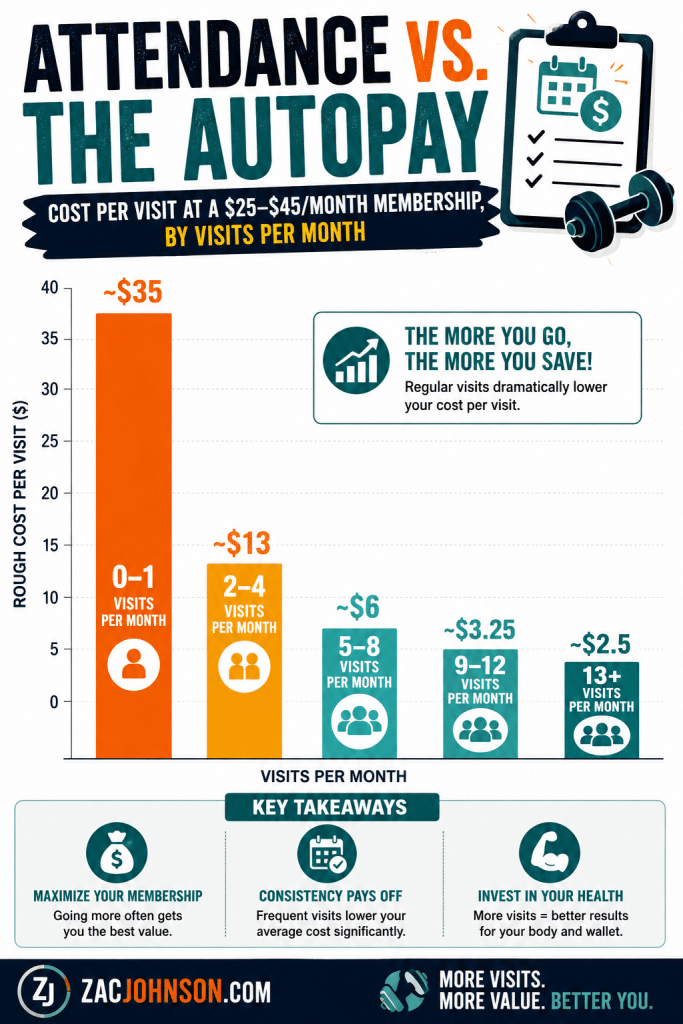
Here’s roughly how the cost per visit shakes out at a typical standard gym rate, somewhere in the $25 to $45 monthly range depending on the market and tier.
| Visits per month | Monthly cost | Cost per visit |
|---|---|---|
| 0 to 1 | $25-$45 | $25-$45+ |
| 2 to 4 | $25-$45 | roughly $8-$18 |
| 5 to 8 | $25-$45 | roughly $4-$8 |
| 9 to 12 | $25-$45 | roughly $2.50-$4 |
| 13+ | $25-$45 | under $3 |
These ranges come from typical published membership tiers and general attendance patterns people report, not a formal study. Your actual numbers will vary by location and plan, so treat this as a starting point for your own math, not a fixed rule.
The break-even point most people are chasing without realizing it sits somewhere around eight to nine visits a month. Below that, a pay-per-visit option or a class pack often comes out cheaper.

A Second Worked Example: The Family Plan
The math changes once more than one person is on the membership, and this is where a lot of households lose track of the real number.
Keep Reading
|
Say a family plan runs $70 a month for two adults. On paper that looks worse than a solo membership. Split it by combined visits and it often looks better.
If one adult goes twice a week and the other goes once a month, that’s roughly nine visits combined. Run the same division as before and the cost per visit lands under $8, which is a completely different picture than either person would get calculating alone.
This is the same blind spot that shows up in a lot of the “normal” household expenses that quietly drain a budget without anyone running the actual numbers behind them. A shared plan hides the true cost inside a single combined line item.

The Freeze Option Nobody Uses
Most gyms offer a freeze or hold option, and most members never ask about it. That’s worth a five-minute phone call before a full cancellation.
A freeze typi