Three Delivery Fees, One Bad Habit: The Real Cost of Never Leaving the Couch
Some links may be affiliate links. We may earn a commission at no extra cost to you. View our full disclosure.
The couch never once charged me a delivery fee. My phone did that part.
I’ve watched my own order totals creep up for years without stopping to ask why. Turns out it’s rarely one price. It’s three fees, stacked quietly on top of each other.
None of the three are hidden, exactly. They’re just spaced out enough on the checkout screen that almost nobody adds them up in their head before tapping confirm.
This guide breaks down what each fee is actually for, what a habit of ordering in tends to cost over a normal month, and when the convenience is genuinely worth paying for anyway.

The Fee You See First
The delivery fee is the one everyone already knows about. It’s printed right on the checkout screen, usually somewhere between two and eight dollars depending on distance, demand, and how busy the app’s drivers are that night.
What most people don’t clock is how much that number moves. Order at 7pm on a weekend and you’re often paying double what the exact same order would cost at 2pm on a Tuesday.
That’s not an accident. It’s a normal expense that quietly scales with how tired you are, and tired is exactly when most people order.
The Fee Hiding in the Menu
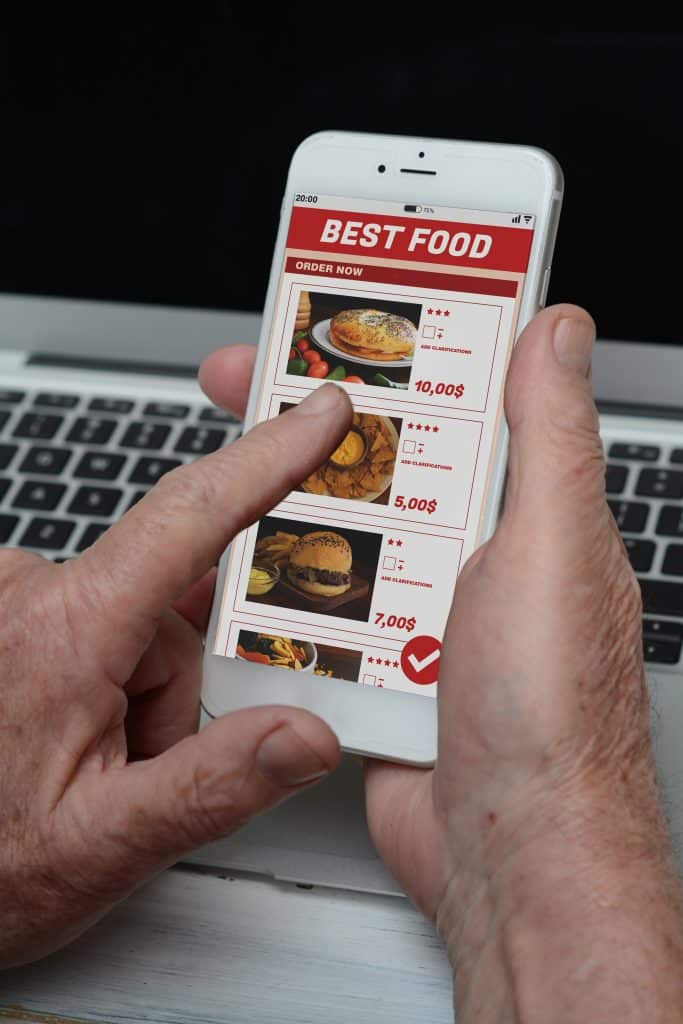
Here’s the one that actually surprises people. The food itself is usually marked up on the food delivery app, separate from any delivery charge at all.
A burger that costs eleven dollars at the counter might list for thirteen or fourteen inside the app. Multiply that across a whole order and you’re often looking at a ten to twenty percent markup before a single fee gets added.
Restaurants do this on purpose. The app takes a commission on every sale, sometimes close to a third of the ticket, and the menu price is how that gets clawed back from the customer instead of the restaurant.
| Keep Reading — 29 Things Frugal People Refuse to Buy (And What They Do Instead) |
I don’t think that makes anyone a bad shopper for not noticing. It’s built to be missed, which is worth remembering the next time you’re deciding what actually deserves a second look before you buy it.
Worth Checking: Pull up the same restaurant’s website or in-person menu once. Comparing it to the app price is the fastest way to see your personal markup number.
The Fee You Add Yourself
The third fee isn’t a fee at all technically. It’s the tip screen, and it’s designed to make you feel like a jerk for choosing the lower number.
Default suggestions on most apps run 18 to 25 percent, calculated on top of the already marked-up food total, not the restaurant’s real price. That’s a meaningfully bigger tip than the same percentage at a sit-down table.
I still tip drivers well. The job is genuinely hard and the pay structure behind it is its own mess.
But I’ve also started typing in a dollar amount instead of hitting the pre-set percentage buttons, because the buttons are calculated on the number the app wants me looking at, not the number I actually agreed to.

The Subscription That’s Supposed to Fix This
Most food delivery apps now sell a monthly membership that waives the delivery fee entirely. On paper it sounds like the fix for everything in this guide so far.
In practice it usually just shifts the math instead of solving it. The menu markup stays exactly the same, the tip screen stays exactly the same, and now there’s a monthly charge sitting quietly in the background too.
For a household that orders four or more times a month, the membership can genuinely pay for itself on the delivery fee alone. For a household ordering once or twice, it’s usually a wash at best, and a slow leak at worst if the orders taper off and the membership doesn’t.
I’d treat it the same way I’d treat any other purchase frugal people tend to question before signing up for. Run the actual math on your own order frequency first. Don’t assume the membership is a discount just because it’s marketed as one.
| Keep Reading — 18 Black Friday Traps (And What's Actually Worth Buying) |

What Three Fees a Week Actually Adds Up To
Here’s a hypothetical illustration, not a prediction or recommendation. Say a household orders in three times a week, averaging thirty five dollars in food before anything gets added.
Once the menu markup, delivery fee, service fee, and a reasonable tip land on top, that same order often lands closer to fifty two dollars. Across three orders a week, that’s a gap of roughly fifty dollars, every single week, that never shows up as a line item anywhere.
Over a year, a habit like that can run into the low thousands. Nobody sits down and decides to spend that. It happens four dollars at a time, which is exactly how small money leaks turn into five figure totals without anyone noticing along the way.
Methodology note: these ranges come from comparing typical app checkout totals against the same restaurant’s counter or website pricing across a handful of common order types. Actual markups vary by city, restaurant, and app, so treat the numbers as a general shape rather than an exact figure for your household.
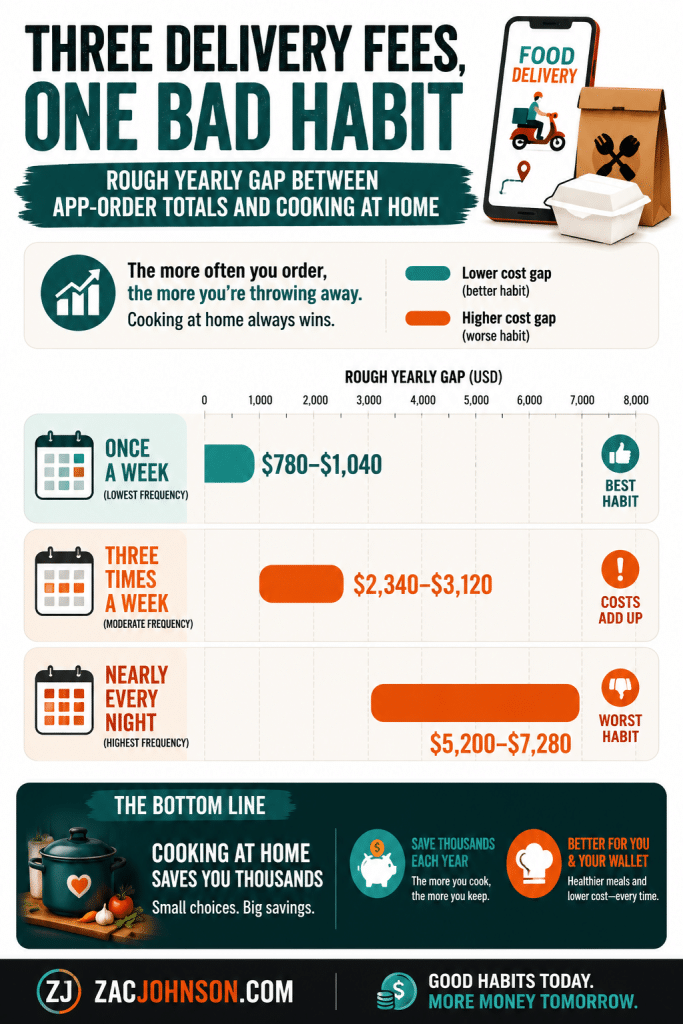
| Order Frequency | Typical Weekly Gap | Typical Yearly Gap |
|---|---|---|
| Once a week | $15 to $20 | $780 to $1,040 |
| Three times a week | $45 to $60 | $2,340 to $3,120 |
| Nearly every night | $100 to $140 | $5,200 to $7,280 |
When the App Is Actually Worth It
None of this means the food delivery app is a scam or that using it makes someone bad with money. Sometimes it’s genuinely the right call.
A parent home alone with a sick kid, a person recovering from surgery, a night when the alternative is skipping dinner entirely, these are real trades, not failures of willpower.
I’d rather someone order delivery on a hard night than feel guilty about it later. That’s the same reasoning behind a lot of spending people wrongly beat themselves up over. The habit is the problem, not any single order.

A Two Week Test You Can Run Yourself
Skip the spreadsheet. Just screenshot every delivery order for two weeks and circle the three numbers on each receipt: delivery fee, service fee, and tip.
Add them up at the end of the two weeks. Most people are surprised by the total, not because it’s shocking, but because it’s the first time they’ve actually seen it in one place.
|
You might also like
18 Warehouse Club Buys Ranked: What's Worth It in Bulk (And What Never Is) →
|
Try This: Cook one of your usual delivery orders at home once during the test, and compare the total cost including your time. It’s the clearest side by side you’ll get.
From there, the decision is yours to make. Some households cut back to once a week and redirect the difference. Others keep ordering exactly the same and just stop feeling blindsided by the total.
Either answer is fine. This isn’t a rule that says convenience is wrong, it’s just harder to make a real choice about a cost you’ve never actually seen written down.
Before You Close the App
Three fees, one screen, and a habit that’s easy to build without ever meaning to. That’s most of what’s going on here.
If you only take one thing from this, let it be the two week test. It costs nothing and it tells you more than any article, including this one, ever could.
For more on where the rest of a household budget quietly disappears, a few weird habits that actually pay off are worth a look.
Pair that with the habits experts say aren’t actually worth the guilt, since delivery apps are rarely the only place people carry shame about spending that doesn’t deserve it.
And if delivery isn’t even the biggest leak in your month, a few genuinely ridiculous tricks that quietly save thousands might be a better place to look next. Either way, the goal isn’t to never order in again.
It’s just to know the real number before the app decides it for you.