The Coffee Ledger: A Year of Six-Dollar Habits, Tallied Honestly
Some links may be affiliate links. We may earn a commission at no extra cost to you. View our full disclosure.
I want to talk about coffee money, but not the way most articles do it. Most of them want you to feel bad about the cup in your hand. I don’t.
This is a ledger instead. We’re going to add up what a daily coffee habit actually costs over a year, look at the number honestly, and then talk about whether it deserves the guilt it usually gets.

What Counts as “The Habit”
For this ledger, the habit is one drink a day, bought somewhere instead of made at home. Doesn’t matter if it’s from a coffee chain, a corner shop, or a gas station machine. The math only cares about frequency and price.
If you’re buying two or three a day, or a fancier drink than a plain coffee, the numbers below run higher. Adjust as you go. This is meant to be a personal exercise, not a universal number.
Doing the Actual Math
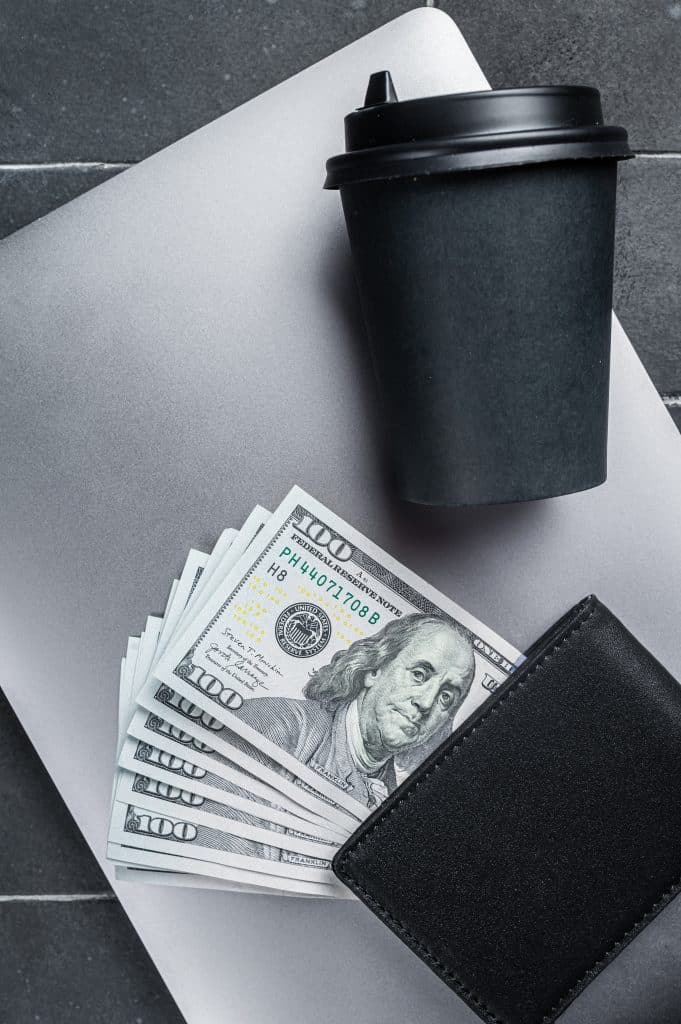
A daily coffee shop drink typically runs somewhere between $4 and $7, depending on where you live and what you order. I’ll use $5.50 as a rough middle figure for this ledger.
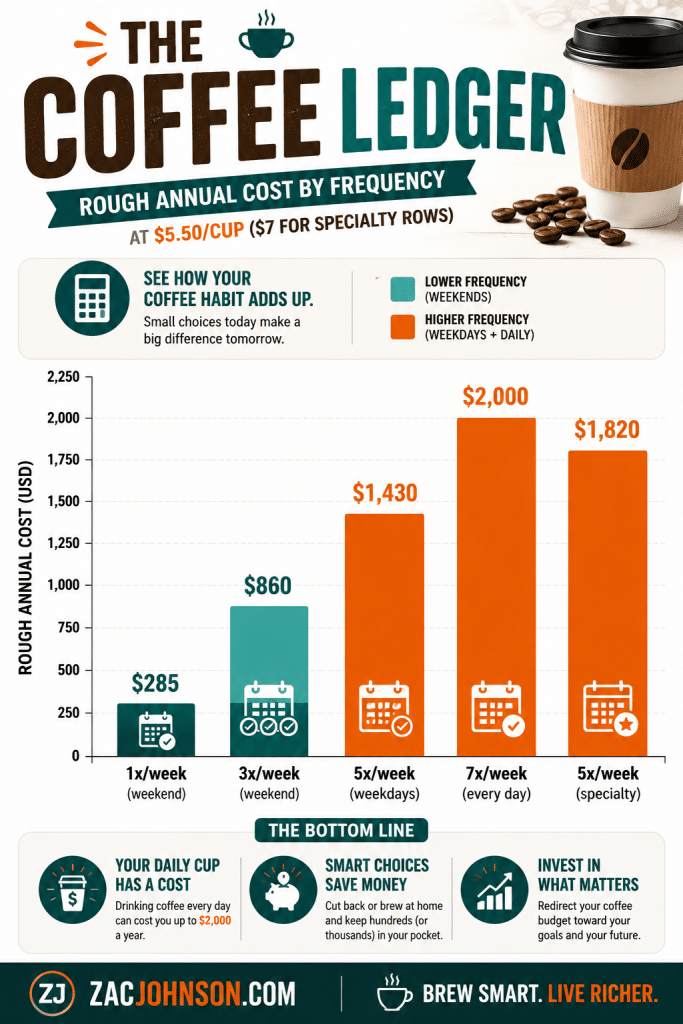
Buy one every weekday, and that’s roughly $1,430 a year. Buy one every single day including weekends, and it climbs to around $2,000.
Those numbers come from typical coffee shop pricing multiplied out across a working year, nothing more precise than that. Your own city, order, and habit will move the number up or down, sometimes by a lot.
The Price Tiers, Broken Down
The number changes a lot depending on two things: how many days a week you’re actually buying, and what you’re ordering. A plain drip coffee and a specialty espresso drink aren’t the same habit financially, even if they feel like one in practice.
|
You might also like
Three Delivery Fees, One Bad Habit: The Real Cost of Never Leaving the Couch →
|
| Days per week | Typical price | Weekly cost | Rough annual cost |
|---|---|---|---|
| 1 (weekend treat) | $5.50 | $5.50 | ~$285 |
| 3 | $5.50 | $16.50 | ~$860 |
| 5 (weekdays) | $5.50 | $27.50 | ~$1,430 |
| 7 (every day) | $5.50 | $38.50 | ~$2,000 |
| 5 (specialty drink) | $7.00 | $35.00 | ~$1,820 |
This table is a starting point, not a verdict. Swap in your own price and your own frequency, and the row that matches your habit is the only one that actually matters.
Run Your Own Numbers: Take your actual drink price and your actual days a week, and do the same multiplication. The real number matters more than mine.
The Advice That Oversold Itself
Here’s the part personal finance writers don’t like admitting. Skipping your coffee habit alone will not fix a shaky financial picture. $1,500 a year is real money, but it won’t undo a car payment that’s too big or rent that eats half your income.
The advice became popular because it’s an easy story. Small daily choice, big yearly number, clean moral lesson. Real financial problems are rarely that tidy.
If skipping your coffee mostly buys you guilt instead of savings, you might be better served by letting go of the mistakes that don’t actually matter.
A lot of the rules behind this kind of advice turn out to be shakier than they sound, something covered in this rundown of money rules that don’t hold up.

Where the Real Leaks Are
If you want to find money without giving up something you enjoy every morning, look at the subscriptions renewing quietly in the background, or a bill you haven’t shopped around on in years. Those tend to be bigger and easier to fix than a coffee habit.
I’ve seen this play out again and again. People agonize over a coffee run while a streaming bundle, a gym membership they don’t use, or an insurance policy nobody’s revisited in five years quietly costs more every month.
Small money leaks like these add up to real money over a decade, and they don’t take any willpower to fix once you spot them.
| Keep Reading — 29 Things Every '90s Kid's Bedroom Had |

The Home-Brew Comparison
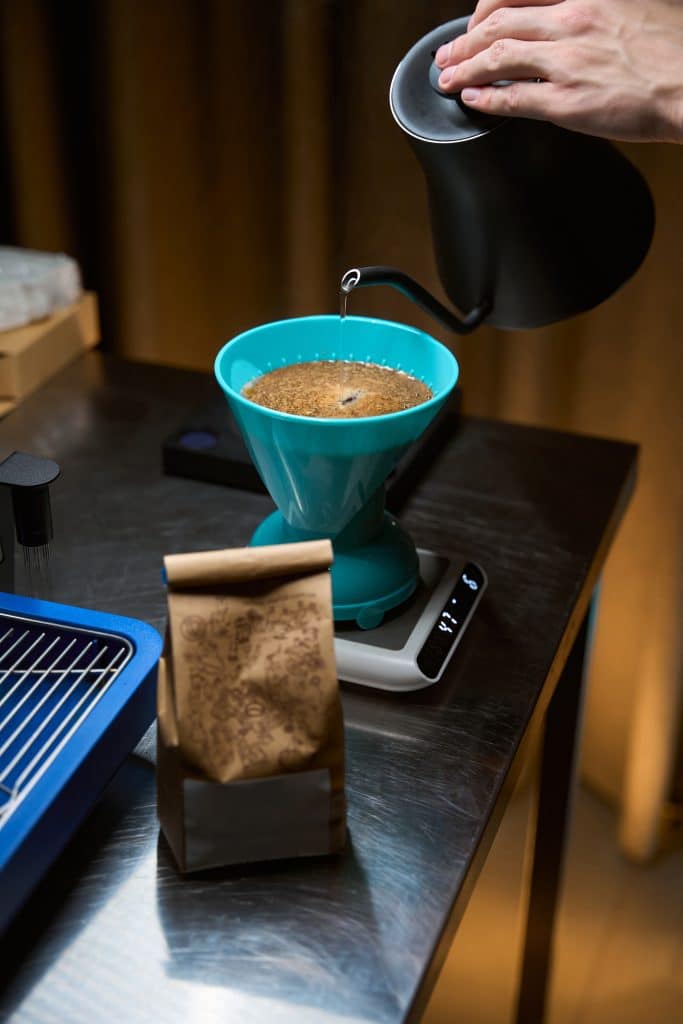
Making coffee at home isn’t free either, and the ledger isn’t honest if it pretends otherwise. Grounds, a filter, and the electricity to run the machine typically land somewhere around 30 to 60 cents a cup.
Against a $5.50 coffee shop drink, that’s a gap of roughly $5 a cup, not the full price of the drink. That’s still real money over a year, but it’s a smaller number than “quit coffee entirely” makes it sound.
If you switch from five coffee shop runs a week to five home-brewed cups instead, the yearly difference is closer to $1,150 than the full $1,430 from earlier. That’s the number worth comparing against your own habit, not the sticker price of the drink alone.
The Two-Week Ledger Test
If you want to know whether your own coffee habit is worth keeping, don’t guess. Run it for two weeks.
Write down every cup, the price, and how you felt about it that day. Not just whether it tasted good, whether it actually mattered to your morning.
At the end of two weeks, add it up and multiply by 26 to get a rough yearly number. Then ask a different question than “should I quit.” Ask “does this number bother me more than the coffee helps me.”
If the answer is yes, there are plenty of small habit swaps that quietly claw back real money without asking you to give up the ritual entirely.

When the Cup Isn’t About the Money
Sometimes the walk to get coffee is the actual product, not the drink. A break in the day, a reason to leave the house, five minutes that belong to nobody else.
I’m not going to tell you that’s a waste. A $1,500 a year ritual that keeps you sane is arguably one of the better purchases on this whole list, and the numbers above don’t capture that at all.
| Keep Reading — 19 Things Smart Shoppers Always Buy Secondhand |
Start the Two-Week Ledger: Grab a notes app or a scrap of paper and start tracking today. You’ll have a real number, not a guess, in fourteen days.

A Quick Gut Check Before You Cut Anything
Before you cut any small daily expense, run it through a simple filter. Would you rather have the thing, or the money? Not in theory, actually.
This is basically the same filter I’d use before any purchase over $100, just scaled down to a $5.50 one. The size of the number doesn’t change whether the question is worth asking.
A coffee habit isn’t inherently one of the quiet “normal” expenses that drain a budget without anyone noticing. It only becomes that when it’s on autopilot and nobody’s checked the yearly total in years.
The Real Number
The honest version of this ledger isn’t “quit coffee and get rich.” It’s “know your number, and decide on purpose instead of by accident.”
Track it for two weeks, do the math, and let the number tell you something instead of assuming it already has.
If habits you’ve been calling “bad” turn out to not matter much, that’s worth knowing too.
And if you’re looking for other easy wins that don’t touch your morning ritual, a few cheapskate tricks that sound ridiculous but actually work are a good place to start.