The Subscription Autopsy: What a Year of “It’s Only $9.99” Actually Costs
Some links may be affiliate links. We may earn a commission at no extra cost to you. View our full disclosure.
Nobody ever cancels a subscription over $9.99. That’s the whole design. It’s priced exactly at the level where checking your bank statement feels more annoying than the charge itself.
I started tracking every recurring charge my household had for exactly one year. Not because I expected it to be shocking, I’ve built budgets before. I did it because I wanted real numbers instead of the vague guilt everyone carries about their subscriptions.
What I found wasn’t really about waste. It was about how easy small commitments become invisible once they’re automated.
This is the autopsy.

The Charge That Never Hurts On Its Own
A single $9.99 charge is basically frictionless. It’s less than a fast lunch, less than a tank of gas top-off, less than most people’s daily coffee habit.
The problem isn’t the charge. It’s that most households aren’t paying just one of them.
Add a streaming service, a music subscription, a cloud storage plan, and a food delivery app membership, and you’re not looking at $9.99 anymore. You’re looking at four or five separate $9.99s, each one individually forgettable.
Canceling any single one of them isn’t exactly a legendary money move, but it’s the kind of small, unglamorous habit that quietly adds up.

Where They’re Actually Hiding
Some subscriptions are obvious. You know you’re paying for a streaming service or two, because you use them weekly.
The sneaky ones are different. A warehouse club membership renews once a year, so it barely registers as a subscription at all, even though the math is identical to any monthly charge stacked up.
| Keep Reading — 33 Cheapskate Tricks That Sound Ridiculous But Quietly Save Thousands |
A gym chain membership can keep charging for months after someone stopped going, because the cancellation process was built to be a little more annoying than the workout itself.
Cloud storage services, meal kit plans, and the big online retailer’s membership shipping program round out the usual list. None of these show up as a single suspicious charge.
They show up as a dozen small, reasonable-looking ones, most of them standing in for things that used to just be free.

The Subscription Price Map
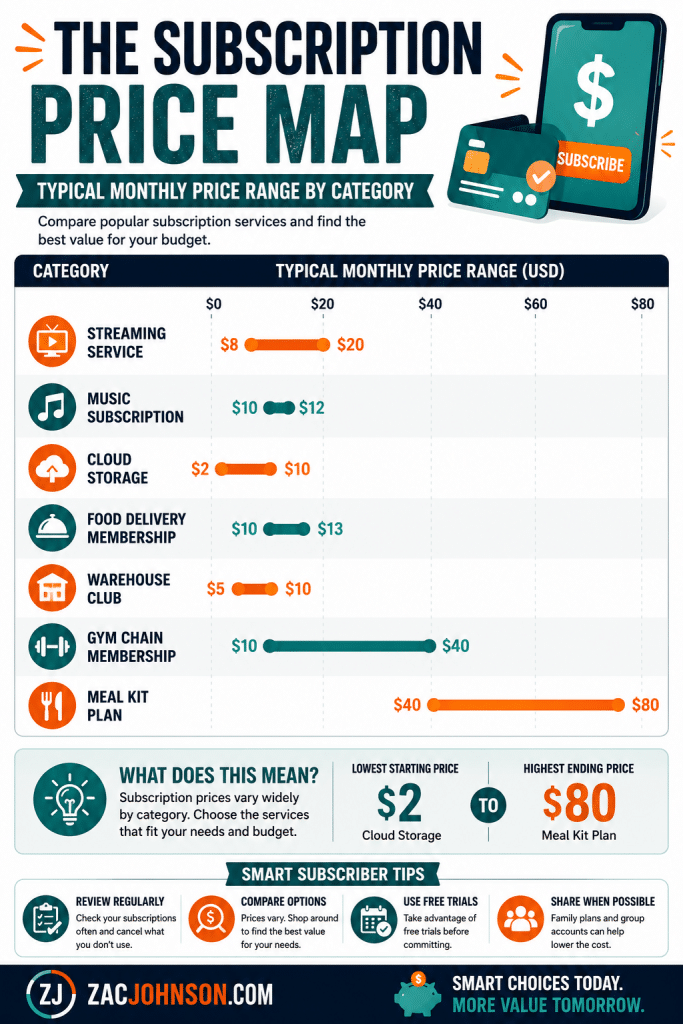
Before the yearly total makes sense, it helps to see what each category actually costs on its own. Prices vary by plan and by promotion, so treat these as typical ranges, not fixed numbers.
| Category | Typical monthly range | What it’s usually replacing |
|---|---|---|
| Streaming service | $8 – $20 | cable, movie rentals |
| Music subscription | $10 – $12 | buying albums or songs |
| Cloud storage plan | $2 – $10 | an external hard drive |
| Food delivery membership | $10 – $13 | per-order delivery fees |
| Warehouse club (paid monthly equivalent) | $5 – $10 | smaller, more frequent shopping trips |
| Gym chain membership | $10 – $40 | a home equipment purchase |
| Meal kit plan | $40 – $80 | grocery shopping and planning time |
Line up whatever you’re actually paying for against this table, and the yearly total stops being an abstract scare number and starts being your own arithmetic.

What a Year Actually Adds Up To
Here’s where the guessing stops and the math starts. Running six to nine active subscriptions at once is closer to typical than rare, based on what I’ve seen across dozens of households.
Stack those up, and the yearly total commonly lands somewhere in the $1,200 to $2,400 range, depending on how many premium tiers and add-ons are involved.
That’s not a scare number. It’s just what $9.99 to $19.99 charges do once there are eight of them running at once, which is its own answer to the money “rule” that small charges don’t count.
A quick note on where that range comes from: it’s a rough average built from typical per-service pricing tiers as of 2026, not a formal survey. Your own total could land well outside it depending on how many services you’re running and which tiers you picked.
The Free Trial That Never Ends
A large share of active subscriptions started as a free trial for something specific: a show everyone was talking about, a project with a deadline, a one-time need.
| Keep Reading — 17 Questions Smart Shoppers Ask Before Buying Anything Over $100 |
The trial converts automatically, the specific reason passes, and the charge just stays. Nobody made a decision to keep paying, the decision just never got made to stop.
This is different from a zombie subscription in one useful way: it’s easy to trace back to a start date. If you can remember the show, project, or event that triggered the signup, you can usually tell whether the reason is still standing.
If it isn’t, that’s not really a hard cancel. It’s just closing a loop that never got closed the first time.

The Zombie Subscriptions
Every household has at least one zombie subscription. It’s the one that’s still charging, but nobody actually remembers signing up for it, or nobody’s opened the app in four months.
These are the ones worth hunting first, because canceling them costs you nothing. You’re not giving up a service you use, you’re just stopping a payment for a service you’d already mentally quit.
A slow scroll through three months of bank statements usually turns up at least one of these, tucked in with other small leaks that quietly cost five figures a decade.
Quick Gut Check: if you can’t remember signing up for it, you already have your answer.

When a Subscription Is Actually the Cheap Option
Not every subscription deserves the guillotine, and treating all of them as waste is its own kind of bad math. A subscription that replaces something you’d otherwise pay full price for, again and again, can be the actual bargain.
A food delivery app membership can beat the cost of eating out, if you were eating out anyway. A cloud storage plan can be cheaper than replacing one lost hard drive of family photos. Context matters more than the sticker price.
This is the part budgeting content usually skips. Canceling everything isn’t a plan, it’s just a different kind of not thinking about it.
|
Rewind
29 Things Every '90s Kid's Bedroom Had
|
It belongs on the same list as other “bad” money habits you don’t actually need to feel guilty about.

The Two-Question Audit
The Audit: two questions, no spreadsheet required.
Question one: did you actually use it in the last 30 days? Not “might I,” not “I could see myself.” Did you open it.
Question two: if this exact subscription didn’t exist yet, and you saw the price for the first time today, would you sign up?
If the honest answer is no to both, that’s your cancel list. If it’s yes to either, it stays, guilt-free, the same way plenty of other money “mistakes” experts say you should stop feeling guilty about stay.

Where to Start
You don’t need to audit everything in one sitting. Pick a slow evening, pull up your bank statement, and run the two questions on whatever’s charging you automatically.
It’s the same instinct behind a good once-a-year money reset.
Subscriptions are just one version of a bigger pattern, the “normal” expenses that quietly drain a bank account without ever feeling like a decision.
Once you’ve done the audit once, it gets faster every year after. Whether you cancel half of them or all of them is a personal call this article doesn’t make. What matters is that you’re making it on purpose, instead of letting it run on autopilot.